W-2 vs. 1099 Workers: Which Is Better For Your Small Business
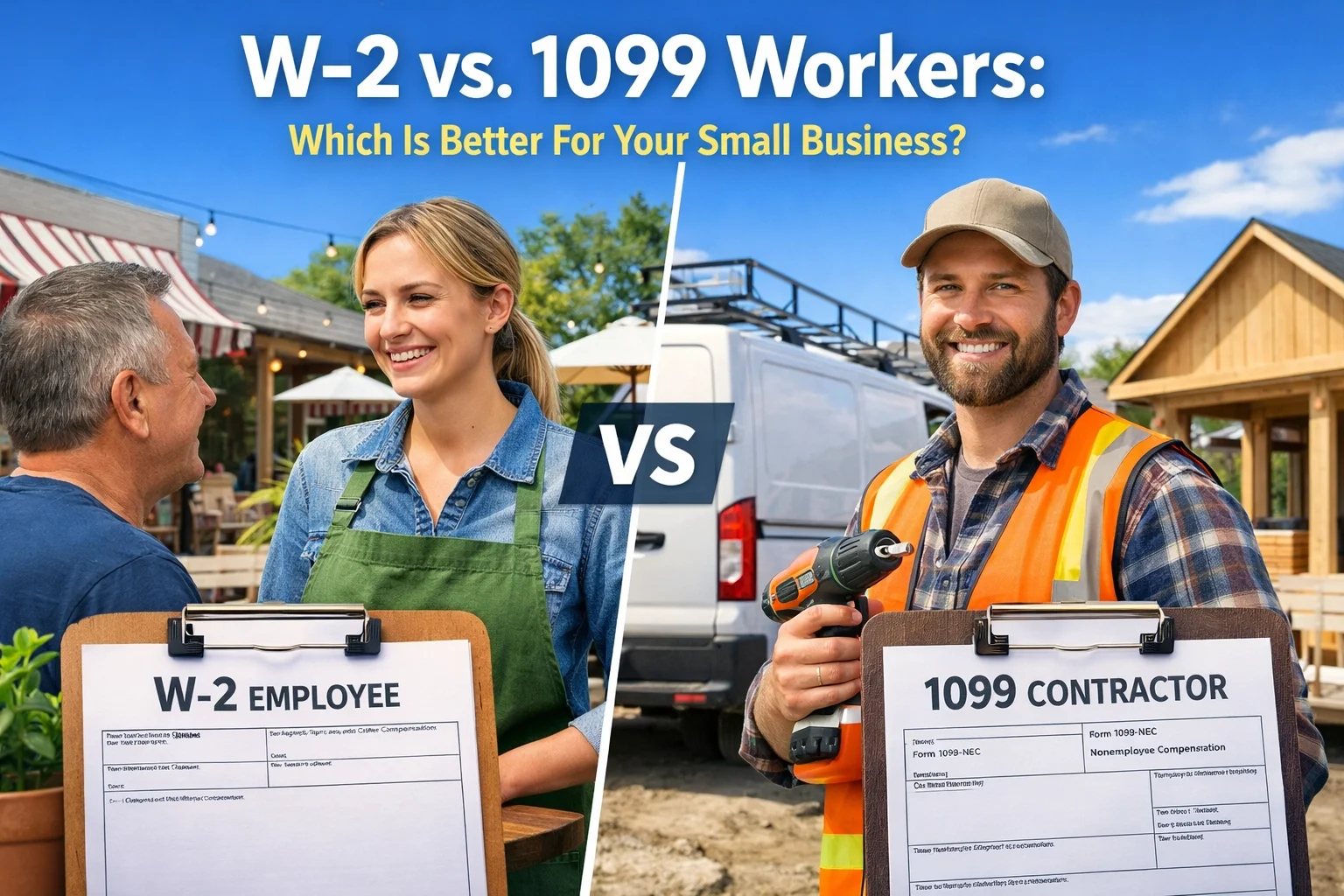
You're growing your business, congrats! But now you're facing a big decision: should you hire W-2 employees or bring on 1099 independent contractors?
This isn't just a paperwork question. The choice affects your bottom line, your tax obligations, your legal liability, and how much control you have over getting the work done right. And if you make the wrong call? Hello, IRS penalties and compliance headaches.
Let's break down the difference between W-2 and 1099 workers so you can make the smartest choice for your business, and understand how we can handle the payroll complexity for you, no matter where you're located.
What's the Difference Between W-2 and 1099 Workers?
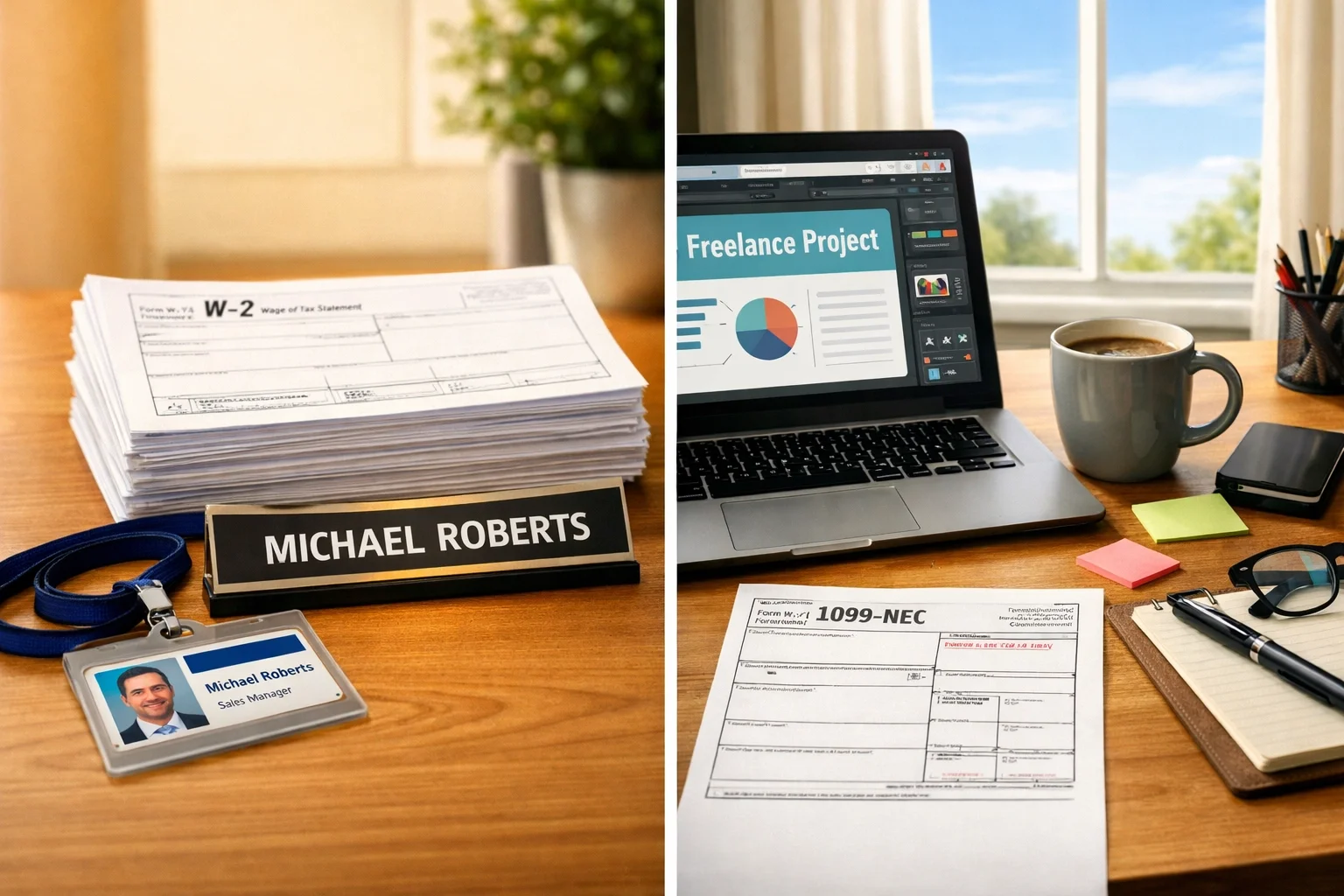
W-2 Employees are people on your payroll. You withhold their income taxes, pay your share of payroll taxes, and have control over when, where, and how they work. At the end of the year, you issue them a W-2 form showing their wages and withholdings.
1099 Independent Contractors are self-employed individuals you hire for specific projects or services. They handle their own taxes, set their own schedules, and generally work how they see fit. If you pay them $600 or more in a year, you'll issue a 1099-NEC form, but that's the extent of your tax responsibility for them.
Think of it this way: employees are part of your team, while contractors are running their own business and you're just a client.
The "Control" Factor: The IRS Is Watching
Here's the real deciding factor the IRS uses to determine whether someone should be classified as a W-2 employee or a 1099 contractor: control.
Do you control how, when, and where the work gets done? If yes, that person is likely an employee.
Signs someone is a W-2 employee:
You set their work hours and schedule
You provide training on how to do the job
You supply equipment, tools, or software
You dictate the methods and processes they use
They work exclusively (or primarily) for your business
The relationship is ongoing and indefinite
Signs someone is a 1099 contractor:
They set their own hours and work location
They use their own tools and equipment
They have specialized expertise you don't need to train
They serve multiple clients, not just you
The relationship is project-based with a clear start and end date
They control how they complete the work, you just define the outcome
Misclassifying workers isn't just a paperwork mistake, it can trigger back taxes, penalties, and even lawsuits. When in doubt, err on the side of W-2 classification, or better yet, let us help you navigate the rules.
The Real Cost: It's More Than Just Hourly Pay
One of the biggest myths? That 1099 contractors are always cheaper because you don't pay taxes or benefits. Not so fast.
W-2 Employee Costs
Yes, W-2 employees come with extra costs beyond their base salary:
Payroll taxes: You pay 7.65% for Social Security and Medicare (the employee pays another 7.65%)
Unemployment insurance: Federal and state unemployment taxes
Workers' compensation insurance: Required in most states
Benefits: Health insurance, retirement contributions, paid time off
Equipment and workspace: Computers, desks, software licenses
Training and onboarding: Time and resources to get them up to speed
When you add it all up, the total cost of a W-2 employee is typically 20-30% more than their base pay.
1099 Contractor Costs
Contractors typically charge 40-50% more per hour than what an equivalent W-2 employee would earn. Why? Because they're covering their own taxes (the full 15.3% self-employment tax), health insurance, retirement, equipment, and the gaps between projects.
Example: If you'd pay a W-2 employee $20/hour, expect to pay a 1099 contractor $28-30/hour for the same work.
The catch? For long-term, consistent work, W-2 employees become more cost-effective because contractors' higher rates eventually outweigh the benefits and tax savings.
Bottom line: Use 1099 contractors for short-term, specialized projects. Use W-2 employees for core, ongoing roles.

Tax Implications for You as the Employer
Let's talk taxes: because this is where things get real.
With W-2 Employees, You Handle:
Withholding federal and state income taxes from every paycheck
Matching payroll taxes: 7.65% for Social Security and Medicare
Filing quarterly payroll tax returns (Form 941)
Paying federal and state unemployment taxes
Issuing W-2 forms by January 31st each year
Managing year-end payroll tax reconciliation
It's a lot. And if you mess up withholding or miss a deadline? The penalties add up fast.
With 1099 Contractors, You Handle:
Issuing 1099-NEC forms if you paid them $600+ during the year
That's it
Contractors pay their own estimated taxes quarterly, including the full 15.3% self-employment tax. They also get to deduct business expenses like home office costs, mileage, and equipment: benefits W-2 employees generally can't claim.
Sounds easier, right? It is: if the person truly qualifies as a contractor. Misclassify someone, and you could be on the hook for all the payroll taxes you should have been paying, plus penalties and interest.
Pros and Cons: Quick Reference
W-2 Employees
Pros:
More control over how and when work gets done
Build a loyal, committed team
Easier to train and integrate into your company culture
Legal protections for them mean less risk for you in certain situations
More cost-effective for consistent, long-term roles (30+ hours/week)
Cons:
Higher overhead: taxes, benefits, insurance, equipment
More administrative work: payroll, tax filings, compliance
Less flexibility to scale up or down quickly
Legal obligations: minimum wage, overtime, family leave, workers' comp

1099 Contractors
Pros:
Lower administrative burden (no payroll taxes or withholding)
Flexibility to bring in specialized expertise as needed
Scale your workforce up or down without long-term commitments
No obligation to provide benefits or paid time off
Cons:
Higher hourly rates (typically 40-50% more than equivalent W-2 pay)
Less control over how work gets done
No guarantee of availability when you need them
Risk of misclassification if you treat them like employees
The Misclassification Trap: Don't Go There
Here's a scenario we see too often: a business owner hires someone as a "contractor" to save on taxes, but then treats them exactly like an employee: setting their schedule, providing training, requiring them to work on-site, and keeping them around indefinitely.
That's misclassification, and it's a big problem.
The IRS, Department of Labor, and state agencies are cracking down on this. If you're caught, you could face:
Back payment of payroll taxes you should have withheld
Penalties and interest on those unpaid taxes
Fines for not providing workers' comp insurance
Legal claims for unpaid overtime or benefits
Audits that dig into all your worker classifications
If someone is doing the work of an employee, pay them as an employee. Period.
How We Handle the Payroll Complexity for You
Whether you choose W-2 employees, 1099 contractors, or a mix of both, we've got your back.
At Leo Aguilera Balanced Books, we take the stress out of payroll and tax compliance:
For W-2 Employees:
Process payroll accurately and on time
Calculate and withhold all federal, state, and local taxes
File quarterly and annual payroll tax returns
Handle unemployment insurance and workers' comp reporting
Issue W-2 forms by the deadline
Keep everything compliant so you can sleep at night
For 1099 Contractors:
Track payments throughout the year
Ensure accurate 1099-NEC filing by January 31st
Help you avoid misclassification issues with proper documentation
Nationwide Service, Cloud-Based Convenience:
No matter where your business is located, we can manage your payroll and tax obligations remotely using secure, cloud-based technology. You get expert service without geographical limits: just reliable, accurate bookkeeping and payroll management from a team that knows the rules inside and out.
Making the Right Choice for Your Business
So, which is better: W-2 or 1099?
The honest answer: it depends on your needs.
Need consistent work done your way? Hire W-2 employees.
Need specialized skills for a short-term project? Bring on 1099 contractors.
Building a core team? Go W-2.
Testing out a new role or service? Start with 1099.
And whatever you choose, don't try to DIY your way through payroll taxes and compliance. The rules are complicated, the penalties are steep, and your time is better spent running your business.
Let us handle the numbers while you focus on growth. We'll make sure your payroll is accurate, your taxes are filed on time, and your classifications are bulletproof.
Ready to simplify your payroll? Get in touch with us today for a FREE consultation. We'll show you exactly how we can take payroll off your plate (no matter where you're located.)