1099 Threshold Changes Explained in Under 3 Minutes (What Small Business Owners Need to Know for 2026
If you've been dreading 1099 season, we've got some good news for you. The IRS has officially raised the 1099 reporting threshold: and it's going to make your life a whole lot easier.
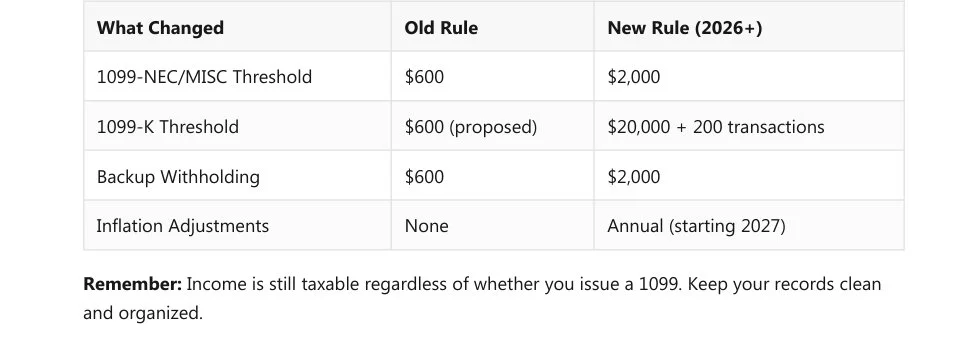
Starting with payments made in 2026, you won't need to issue a 1099 unless you've paid a contractor or vendor more than $2,000 (up from the old $600 limit). That's a big deal for small business owners who've been buried in paperwork for relatively small payments.
Let's break down exactly what changed, what stayed the same, and what you need to do to stay com pliant without losing your mind.
The Big Change: $600 Becomes $2,000
For years, the magic number was $600. If you paid a contractor, freelancer, or vendor $600 or more during the tax year, you had to send them (and the IRS) a 1099 form. Simple in theory: but a headache in practice when you're juggling dozens of small payments.
Now, that threshold has jumped to $2,000 for payments made on or after January 1, 2026.
This applies to:
1099-NEC (Non-Employee Compensation) : what you send to independent contractors
1099-MISC (Miscellaneous Income) : for things like rent payments, prizes, and other reportable in come
What does this mean for you? Fewer forms to prepare, fewer W-9s to chase down, and less time spent on administrative busywork. You can finally focus on running your business instead of drowning in tax paperwork.

What About 1099-K? (PayPal, Venmo, Stripe Users, Listen Up)
If you accept payments through third-party platforms like PayPal, Venmo, or Stripe, there's more good news.
The 1099-K threshold has been restored to $20,000 in payments AND 200 transactions. This is a major relief compared to the proposed $600 threshold that had gig workers and small sellers panicking.
So if you're selling products online, accepting digital payments, or doing freelance work through payment apps, you won't receive a 1099-K unless you hit both of those benchmarks. That takes a lot of pressure off small sellers and side hustlers.
Backup Withholding Got Easier Too
Here's a detail that often flies under the radar: backup withholding.
When a contractor or vendor doesn't provide you with a valid Tax Identification Number (TIN), you're technically supposed to withhold 24% of their payment and send it to the IRS. It's called "backup withholding," and it's been a compliance nightmare for small businesses.
The good news? The backup withholding threshold has also increased to $2,000. That means you don't need to worry about withholding on smaller payments to vendors with missing or incorrect TINs: unless those payments exceed $2,000.
One less thing to stress about.
What Stays the Same (Don't Skip This Part)
Before you start celebrating, there's one critical thing that hasn't changed: all income is still taxable, whether or not a 1099 is issued.
Just because you don't have to send a 1099 for a $1,500 payment doesn't mean that contractor is off the hook for reporting that income. And it doesn't mean you can ignore proper record-keeping.
Here's what you still need to do:
Keep accurate records of all payments to contractors and vendors
Collect W-9 forms from anyone you might need to issue a 1099 to (even if you're not sure yet)
Track payment totals throughout the year so you know when you've crossed the $2,000 thresh old
Stay organized so you're not scrambling in January
The IRS may not require a form for smaller payments, but they still expect you to maintain proper documentation. If you're ever audited, you'll need to show your records are in order.
Timeline: When Does This Actually Take Effect?
This is where it gets a little tricky, so pay attention.
For the 2025 tax year (forms you file in early 2026): The old $600 threshold still applies. If you paid a contractor $600 or more in 2025, you need to send them a 1099 by January 31, 2026.
For the 2026 tax year (forms you file in early 2027): The new $2,000 threshold kicks in. Only pay ments made from January 1, 2026 forward fall under the new rules.
So if you're prepping 1099s right now for last year's payments, you're still working with the $600 limit. The relief comes next year.
Future-Proofing: Inflation Adjustments Are Coming
Starting in 2027, the IRS will adjust the $2,000 threshold annually for inflation. This means the thresh old could gradually increase over time, keeping pace with rising costs and reducing your filing burden even further.
It's a small but meaningful change that shows the IRS is (finally) recognizing the administrative strain on small businesses.
A Quick Recap: What You Need to Know
Let's sum it up so you can get back to running your business:

How Leo Aguilera Balanced Books Can Help
Look, we get it. Even with a higher threshold, 1099 prep can still feel overwhelming: especially when you're trying to run a business, manage employees, and keep customers happy.
That's where we come in.
At Leo Aguilera Balanced Books, we handle 1099 preparation and filing so you don't have to. We'll make sure you're compliant, organized, and stress-free when tax season rolls around.
Here's what we can do for you:
Track contractor payments throughout the year so nothing slips through the cracks
Collect and verify W-9s from all your vendors and contractors
Prepare and file 1099 forms accurately and on time
Keep your records organized in case you ever need them for an audit
Answer your questions so you always know where you stand
You've got enough on your plate. Let us take the 1099 headache off your hands
Ready to Simplify Your Bookkeeping?
If you're tired of chasing paperwork and worrying about compliance deadlines, we'd love to help. Our team specializes in making bookkeeping and tax prep simple, accurate, and stress-free for small business owners just like you.
Get in touch with us today to learn how we can support your business: whether it's 1099 filing, pay roll, bookkeeping catch-up, or year-round financial peace of mind.
You focus on growing your business. We'll handle the numbers.